How VALORANT Champions Shanghai group stage reshaped the 2026 title race
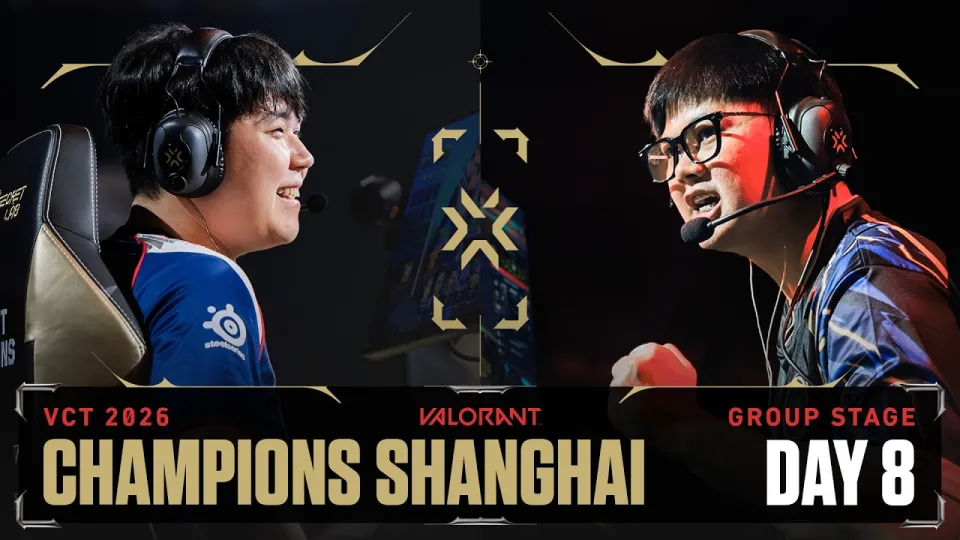
Video: VALORANT Champions Shanghai — Group Stage — Day 8
You can order the same kind of articles for your own video to boost it on YouTube and Google. Just message the Telegram bot @sat_sit_bot. Articles with your video embedded are written and posted by the bot itself — on popular topical sites (no ads). Your first 50 articles are free.
· based on the channel VALORANT Champions Tour
Key takeaways
- VALORANT Champions Shanghai runs September 24 to October 18 with 16 teams from Americas, CN, EMEA and Pacific.
- All four Chinese representatives were eliminated in the group stage, ending the host region's run before playoffs.
- JD Gaming lost a 6-11 lead on the opening map against T1, a comeback the region had rarely conceded on the global stage.
- Day 8 of the group stage featured T1 vs JD Gaming, a three-map series with a technical pause in game one.
- A silenced Crown ultimate and a disputed Omen hit-registration moment became the most debated clips of the broadcast.
VALORANT Champions Shanghai is the 2026 world championship for Riot's tactical shooter, and its group stage decided which of the 16 invited teams would survive into the playoff bracket. The event runs from September 24 to October 18, bringing together rosters from the Americas, China, EMEA and Pacific to crown a single world champion. For live brackets, schedule updates and official announcements, the tournament's primary hub is the official VALORANT Esports account on X, which posts results and match-day information as they happen.
Day 8 of the group stage, published by the VALORANT Champions Tour channel, captured the exact moment the tournament's story turned: a host region collapsing, a favourite surviving a scare, and a new generation of challengers proving that the gap between regions has closed.
What the VALORANT Champions Shanghai group stage format actually decides
The group stage is the filter that turns 16 teams into a playoff field, and every match carries elimination risk. Teams are split across groups, play a round-robin or double-elimination structure depending on seeding, and the top finishers advance while the rest go home before the bracket stage. Because Shanghai hosted the event, Chinese squads entered with crowd support but also with the heaviest pressure of the tournament.
That pressure produced the defining storyline of the stage: all four Chinese teams were eliminated before the playoffs. For a region that has invested heavily in infrastructure and received dedicated VCT slots, a 0-4 exit on home soil was the harshest possible outcome, and it immediately reopened the debate about whether China should compete as a standalone region or fold back into the wider Pacific ecosystem.
Day 8 spotlight: T1 vs JD Gaming and the 6-11 collapse
Day 8's headline series was T1 against JD Gaming, a matchup that decided which side kept its tournament alive. JD Gaming opened strongly and built a 6-11 lead on the first map, a position that historically would have been enough for a Chinese team to close out against an international opponent. They did not close it. T1 clawed the map back, forced the series long, and the momentum never returned to JDG.
By the third map, JD Gaming's structure had visibly broken down, and the series slipped away. Analysts and viewers alike pointed to that first-map throw as the moment the group stage was lost, because a 2-0 sweep would have changed the entire seeding picture for the region. The broadcast also featured a technical pause during the opening game, a reminder of how much competitive weight rests on server and client stability at this level.
Why the silenced Crown and hit-registration clips went viral
Two moments from the broadcast dominated community discussion more than any round result. The first was a Crown ultimate being silenced mid-fight, a rare interaction that viewers described as the most satisfying moment of the entire match because it removed a team's safest defensive tool at the worst possible time. Ability-denial plays like this are exactly why utility timing matters as much as aim at the top level.
The second was a disputed hit-registration sequence in which three bullets appeared to connect with Omen but only two registered as damage. Clips like this always spark debate about server tick rate, interpolation and how the client renders shots versus how the server resolves them. Riot has not commented publicly on that specific round, and it did not change the series outcome.
The regional curse argument and what it gets wrong
The most repeated theory after the group stage was that a "regional curse" explains China's failure at international events. The stronger explanation is simpler: most teams perform better at home because of crowd energy, travel recovery and practice conditions, and the Chinese squads simply were not ready for the level of opposition they met.
Consider the evidence:
- JD Gaming had a winning position on map one and could not convert it, which is a preparation and composure problem, not a curse.
- The rest of the region lost series without ever forcing a deciding map, suggesting a wider gap in mid-round calling and utility usage.
- Meanwhile, teams from the Americas, EMEA and Pacific arrived with sharper default setups and better adaptation after losing pistols.
Hosting a world championship in a region whose current strength is its weakest link is a scheduling reality, not a competitive advantage. The crowd in Shanghai was loud, the venue was world-class, and none of that compensates for losing the first three rounds of every map.
Roster experiments that raised eyebrows
One of the more surprising decisions of the stage was fielding a player historically known for support and initiator roles on a duelist. Viewers questioned the move immediately, and the results did not silence them: entry timing, first-blood conversion and space creation all looked off compared to dedicated duelist play.
Coaches make these swaps for two reasons: to unlock a specific map pool or to counter an opponent's expected composition. When it works, it looks like genius. When it fails, it exposes the roster's lack of role depth. At Champions level, where every group match can end a season, that gamble is expensive.
What to watch in the Shanghai playoffs
The group stage answered one question and raised three more. It confirmed that the 2026 season produced genuine parity at the top: two different Masters events crowned two different champions, and no single region dominated the group stage. It raised questions about China's competitive direction, about whether dedicated slots should be re-evaluated, and about how much weight to give a single map's worth of momentum in a three-map series.
For viewers following the bracket, the teams to track are the ones that won without needing a third map. Series sweeps preserve energy, hide prepared compositions and keep opponents guessing. Teams that survived five-map group grinds enter the playoffs with exposed tendencies and tired legs.
Useful links
- Official VALORANT Esports on X: https://x.com/valorantesports
- Facebook: https://www.facebook.com/ValorantEsports/
- Instagram: https://www.instagram.com/valorantesports/
- TikTok: https://www.tiktok.com/@valorantesports
- Twitch: https://www.twitch.tv/valorant
The group stage verdict
The Shanghai group stage delivered the clearest signal of the 2026 season: the old hierarchy is gone, and no region can coast on reputation. A host region exited without a single team in the playoffs, a favourite nearly lost a series it controlled, and the community spent more time debating one silenced ultimate and one hit-registration clip than any individual scoreline. The VALORANT Champions Tour channel's Day 8 broadcast is the best single record of that turning point, and it is worth watching in full before the playoff bracket begins. For everything that comes next, follow the official VALORANT Esports account on X so you do not miss a single result.
FAQ
Did any Chinese team reach the VALORANT Champions Shanghai playoffs?
No. All four Chinese representatives were eliminated during the group stage, which ended the host region's run before the bracket began. The exits were especially painful because JD Gaming had a 6-11 lead on the opening map of their deciding series and could not close it out.
Was the Omen hit-registration moment a bug?
Viewers pointed out that three bullets appeared to hit Omen while only two registered as damage. Without an official statement from Riot, the most likely explanations are server-side resolution differences or client-side rendering, not a confirmed bug. The round did not decide the series.
Why did a Crown ultimate being silenced matter so much?
The Crown is one of the strongest defensive ultimates in the game, so denying it with a silence removed a team's safest fallback in a critical round. Plays like this show that utility timing, not just aim, decides rounds at the highest level of VALORANT.
Which teams look strongest heading into the Shanghai playoffs?
The squads that won their group matches without dropping a map look strongest, because sweeps preserve energy and hide prepared strategies. T1's comeback against JD Gaming also marked them as a team with strong mid-series adaptation, which matters enormously in a three-map playoff format.
Source: VALORANT Champions Shanghai — Group Stage — Day 8 · Markdown version